Year 3 · Retail interior / Brand space / 04
Advanced Spatial Design
Subliminal Retail
A tea-house sub-brand, made spatial
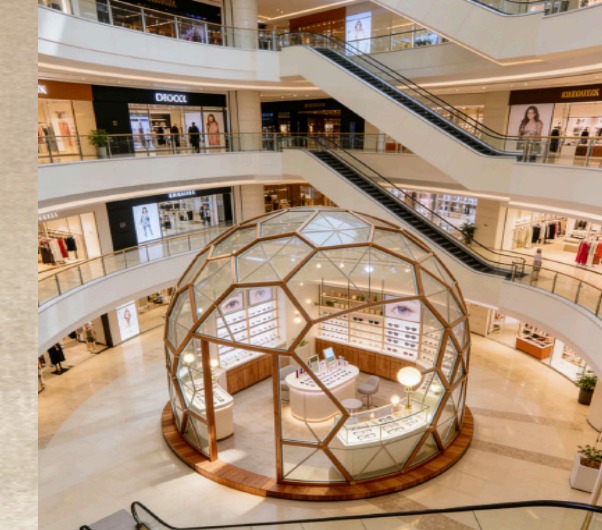
A speculative pop-up for Zhang Yiyuan’s new eye-care sub-brand, translating the cellular structure of jasmine tea into a domed retail landscape.
Context
Zhang Yiyuan is a 120-year-old Beijing tea house with a strong heritage position but limited traction with younger consumers. The project proposes Motong, a cross-border personal care brand that combines oriental plant extracts with modern eye health — and a retail environment that makes the proposition spatial.
The site is a shopping-centre atrium with a high footfall and a mixed audience: office workers, families and students. The brand needs to read as premium without becoming remote.
Question
How can a heritage brand become contemporary without losing its material memory?
Response
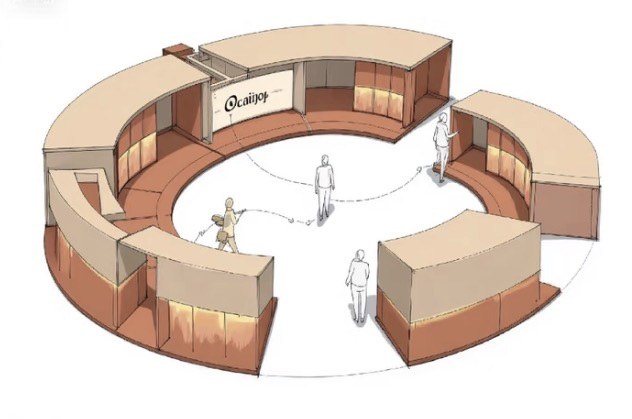
The plan is a central island under a spherical dome and honeycomb frame. Tea-leaf cells become a hexagon grid; the organic growth of the plant becomes the curvature of the dome. Wood and transparent membranes keep the space light. Four product colours — Longhao Brown, Golden Robe, Jade Bud Green and Chu Mo Black — are staged as four micro-landscapes around the island.
The dome is both architecture and display: a single, legible organism rather than a sequence of walls. The visitor walks around the island, seeing the products from different angles, the way one might turn a tea leaf in the hand.
Outcome
The result is a retail interior that behaves like a brand model. It gives the sub-brand a form that can be recognised before it is read, and a spatial language that can travel across formats.
A brand becomes spatial when you can recognise it before you read it.